As a medievalist who is already operating outside the boundaries of traditional medieval studies, the digital humanities (DH) are a significant part of my work- from research, to presentation, to pedagogy. While it is still in its adolescent stage, DH is already showing tremendous potential in allowing scholars to probe new questions, collaborate on new projects, and break down barriers between the academic institution and the public audience. Rendering our research accessible to the public, through open-access mediums and reconsidering conventions of scholarship will be critical to ensuring the sustainability of the humanities in the years to come.
The projects listed below illustrate many of the opportunities DH provides for emerging scholars. The idea of “storytelling” has been a significant part of my research and pedagogy, as I’ve explored the stories we tell to make sense of the world and ourselves throughout time. John D. Niles’ “Poetry as Social Praxis” is a substantial influence on my approach as he identifies six functions of poetry (and I modify to include the act of storytelling):
- The Ludic– to entertain
- The Sapiental– to share wisdom
- The Normative– to build a moral code
- The Consitutive– to structure the world
- The Socially Cohesive– to build community
- The Adaptive– to understand other cultures (pp. 66-88)
I crafted these projects and my research with these characteristics as a throughline—how we understand stories and how we share them. While some were completed as part of graduate coursework, all were independently constructed with the intent of public publication and/or use in an undergraduate class setting.
Projects
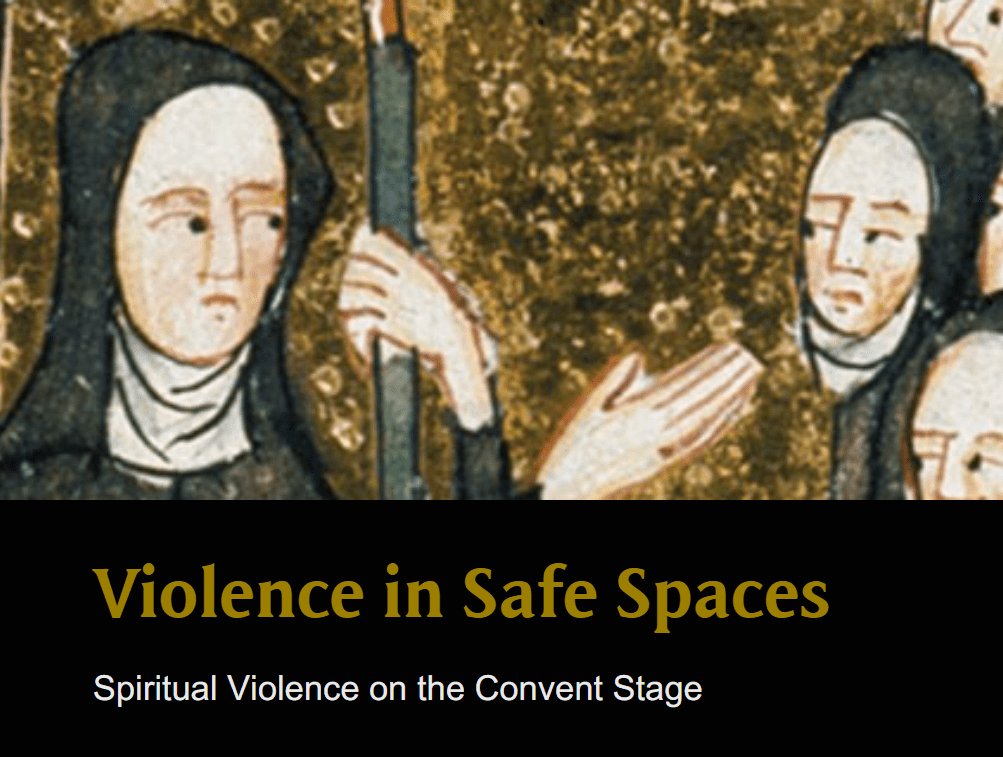
I crafted this project for a Fall 2021 Medieval History class with Dr. Sara Ritchey. Public-facing scholarship was a huge part of our conversation in the class, especially in connecting medieval research to contemporary issues to illustrate the relevance of the humanities to the world. The class itself was centered around elements of performance, and I quickly noted interesting ways in which women, particularly Hrotswitha of Gandersheim and Hildegard von Bingen, strategically staged violent acts on the convent stage. Even more intriguing was how women made use of violence through proxies and directly committing acts themselves!
I connected these examples to the #MeToo movement, which was in full swing by this time. In doing so, I hoped to illustrate that medieval texts are not merely trapped in their own time, but instead continue to be relevant today as we still see women struggling with many of the same issues.
ArcGIS StoryMaps presented an ideal format to include the performative aspects of the source material and allow a public audience to “experience” the works and where they were crafted/performed. I leveraged text, image, and video to set context and background for the audience in a familiar way, with conversational tone and approachable format. While the StoryMap has clear organization, audience members have a variety of ways in which they can engage with the material, accommodating several learning styles.
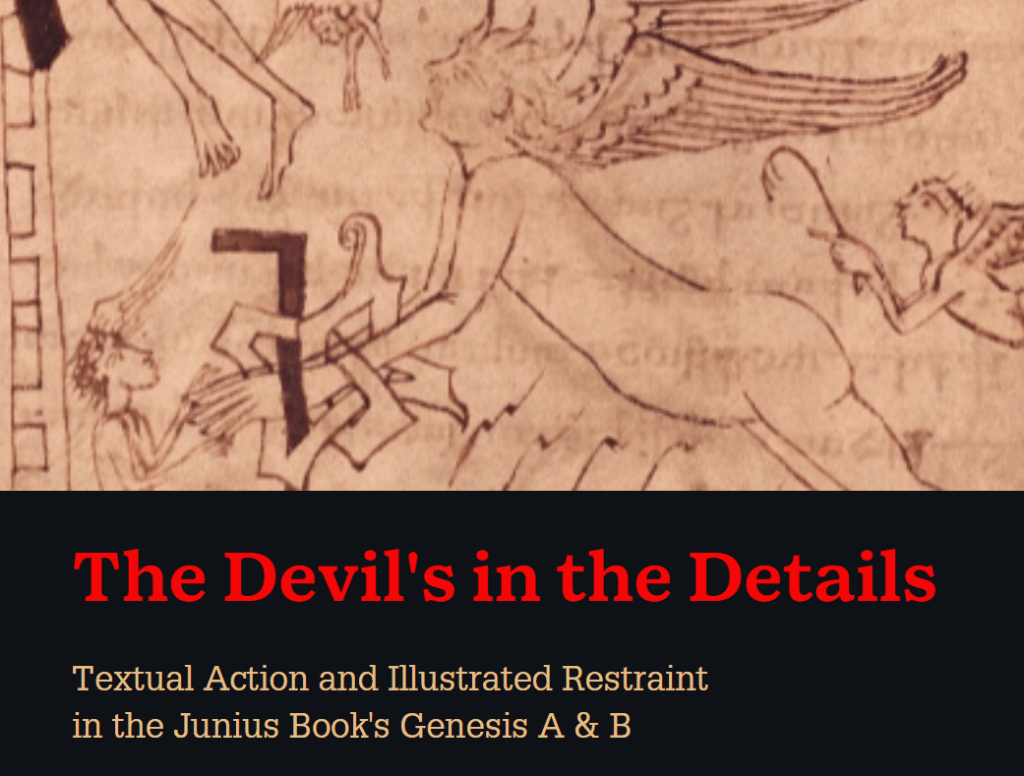
I completed this project for a Fall 2021 Digital Humanities class with Dr. Hilary Havens. During this semester, I was also doing an independent study with Dr. Roy Liuzza in which I translated the Junius Book (Oxford, Bodleian Library MS Junius 11): a 10th century manuscript that adapts Genesis, Exodus, Daniel, and Christ and Satan. Aside from its compelling Old English poetic adaptation, the Junius Book also boasts some of the most captivating images in the corpus. Reminiscent of Quinton Blake’s more recent illustrations in Roald Dahl’s novels, these simple yet detailed drawings depict many of the bible’s key scenes.
While each illustration connects to the context of its textual component, however, I quickly noticed a discrepancy between the more action-based text and restrained drawing. While the poem describes Satan committing many direct acts, the illustrations only show him in positions of restraint: falling into hellmouths, chained to the ground, and cowering in the face of God.
I also chose ArcGIS StoryMaps for this project to explore some different aspects of the format. When it comes to manuscript analysis, one of my biggest frustrations is how to meaningfully engage with the primary text, especially one as visually compelling as the Junius Book. While a print publication can sometimes include figures—typically black and white and hard to see—the audience often has to “flip” between text and image, breaking up the learning process. I designed this format to act as a guided tour through the manuscript’s unique features, “zooming in” on key points and sections of the manuscript scan without losing track of the linear argument. Again, I strove to accommodate a variety of learning styles through incorporation of text, image, and video.
Shot Through the Herte: Voyant Analysis
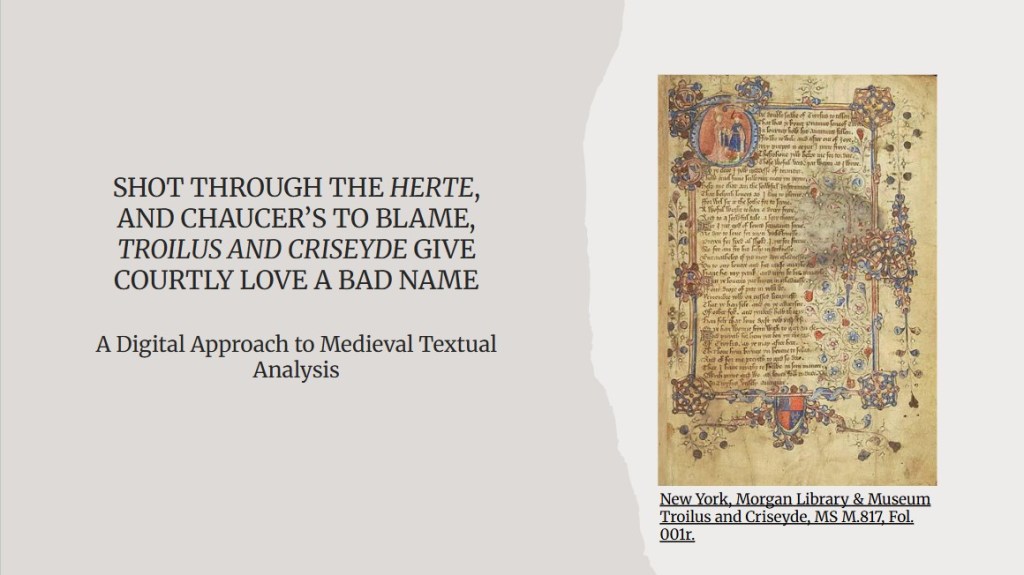
I created this project for the Spring 2022 section of Dr. Howes’ Chaucer & Affect class. Throughout the semester, we examined Chaucer’s use of affect and emotions in his work. As one of his foundational works, Troilus and Criseyde presents a complex view of courtly love that simultaneously celebrates and critiques how love affects the body. Both characters experience the physical effects of love through the framework of the courtly love tradition, with a key component being its physical effects on the heart. Often, these feelings are painful.
I employed Voyant Tools, a web-based text analysis application, to categorize and analyze when Chaucer references the heart, what type of physical reaction he describes, and to whom he attributes the effect. With 248 distinct references throughout the poem, the heart is not only frequently addressed, but it is also the organ most influenced by courtly love, ranking as the fourteenth most-used word and first in physical references.
While the class’s final project was a traditional paper, I wanted to practice using digital tools in research. Voyant Tools allowed me to not only track one term, but I could also consider how it stood against terms used throughout the text. This process saved time and presented new insight I likely would not have had if I was relying on my own charting skills. I later presented this research at the Southeastern Medieval Association’s annual conference, highlighting the digital approach for medieval scholarship.
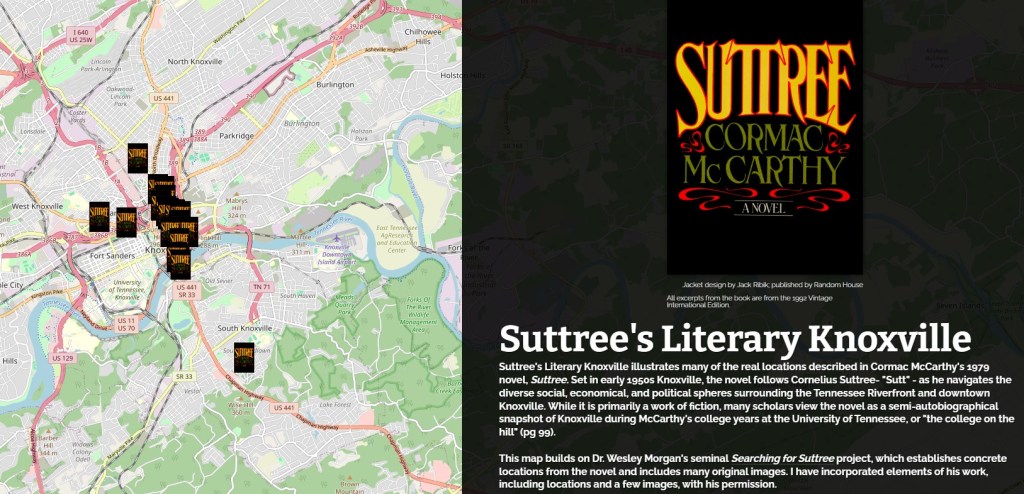
My most ambitious endeavor has been to revise and augment Dr. Wesley Morgan’s digital “Searching for Suttree” map, which he completed in 2004. As the foremost scholar on the real people and physical locations in Cormac McCarthy’s first four “Tennessee Novels,” his original map illustrated the Knoxville locations depicted in McCarthy’s 1979 novel Suttree with images pinned on a 1950’s map sketch of the city. With his blessing, I am updating this map with Storymaps JS, which will allow a wide audience to “experience” Cornelius Suttree’s world then and now with images and video of several locations.
This project will bring the map fully into the 21st century and render the popular “Suttree Walk” accessible for people all over the globe. While the “Walk” was previously only available to those with the ability to travel to Knoxville and/or traverse an urban terrain that isn’t always accessible for those with mobility issues, this map recreates the experience for all. Once completed, I will share it with Texas State University’s Wittliff Collections as part of their curriculum initiative to provide resources for those teaching McCarthy’s novels all over the world, as well as many McCarthy and Knoxville-specific organizations.
Pedagogy

The following is an assignment I use for the coding component of the English 102 Qualitative Project. In this unit, students compose a research question based on the course topic, interview at least three members of a specific demographic, code their responses, and report their findings in a traditional IMRaD paper. Since I encourage students to complete this project in groups with assigned tasks, I create low stakes activities to teach everyone the concepts underpinning each step.
While it is not a perfect application for coding purposes, Voyant Tools is an exceedingly user-friendly way to teach students the opportunities and pitfalls of digital textual analysis. Many students use the visualization and charting features in their final paper drafts, as well as the analysis tools for their interview transcripts.

Archival Research Project Prompt and Examples
The following is the prompt for the English 102 Archival Project. So far in the semester, students have completed the Qualitative unit, where they discovered what a specific demographic thinks about a particular issue/research question. In the archival unit, they extend their research into what a specific demographic thought about the same issue in the past. This research can include synchronic (at one point in time) or diachronic (over a period of time). To find their answers, they use at least three artifacts and conduct primary & secondary research to understand what insights these objects can provide.
Instead of a traditional “paper” format, this project prompt requires students to create a digital museum-style exhibition that incorporates visual and often auditory elements to guide their audience through the exhibit. Students can create an ArcGIS Storymap, a GoogleSite, a videoessay, or other digital means to present their findings.
 The Bad Medievalist